


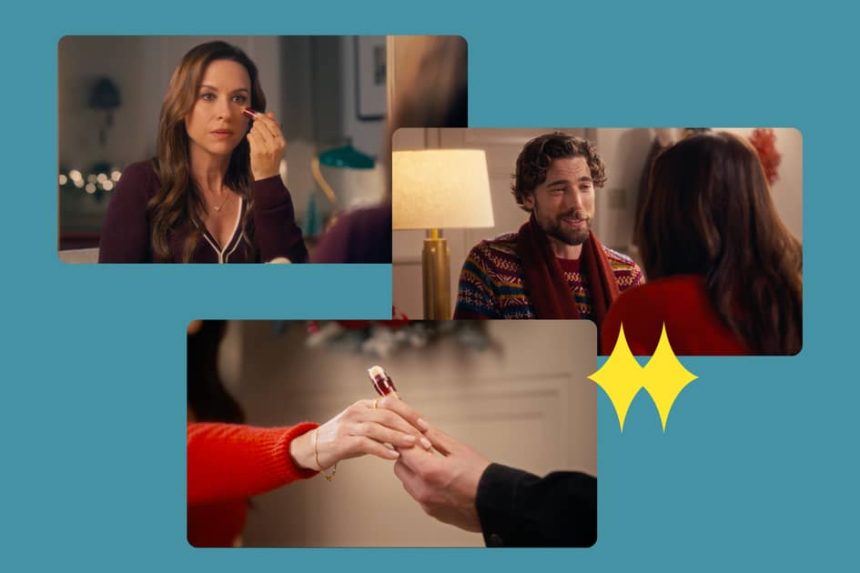
Lacey Chabert is harboring a Christmastime secret—and this time, it’s not that the actress is dating a snowman-turned-hot-man, a lá her role in the holiday rom-com Hot Frosty. But if your interest is piqued, you’ll need to watch five short, dramatic episodes to find out what it is.
For Maybelline’s holiday campaign, Chabert reunited with her Hot Frosty costar Dustin Milligan for a story of romance and intrigue told in the microdrama format first made popular in China. The ad, part of a campaign called “Maybe This Christmas,” spotlights Maybelline’s Instant Eraser Concealer as the couple navigates a mystery and deception plot over the course of five episodes, each one clocking in at one minute long.
Alongside a social campaign and placements across premium holiday programming like the Macy’s Thanksgiving Day Parade stream on Peacock and Chabert’s slate of holiday films on Hallmark, the microdrama also debuted on ReelShort, a platform dedicated to bite-sized content.
Microdramas are growing in popularity in the US, and parts of Hollywood are betting that the format will be more than a fad, but advertisers haven’t yet widely adopted the genre for their campaigns. According to Yasmin Dastmalchi, president of Maybelline New York, Maybelline is one of the first brands to lean in.
“For us, it’s always about showing up where our consumers are and giving them content in formats that they want to consume,” Dastmalchi told Marketing Brew. “We wanted to give them something super bingeable during this holiday season.”
Selling the (micro) drama
Maybelline worked with agency Maximum Effort to ideate and create the five-episode campaign, and Dastmalchi estimated that the entire process—from initial idea to finished product—took less than six weeks. Speed, she emphasized, was a big advantage of both the microdrama format and working with the agency.
“[Maximum Effort is] a partner that really helps shape cultural awareness for the brand, and they execute extremely fast,” Dastmalchi said. “They really understood that we didn’t want to create a traditional ad.”
While the microdrama ad format may be nontraditional, it’s not completely unprecedented. When Maybelline came to Maximum Effort looking to “crack the holiday season,” as Dastmaltchi put it, Maximum Effort’s Kathleen Swanson and Pierce Thiot, the agency’s heads of brand and creative, were reminded of a Taster’s Choice campaign from the ’80s and ’90s, in which Anthony Head (of Buffy the Vampire Slayer fame) flirts with actor Sharon Maughan over borrowed coffee in an episodic series of commercials.
That soap-opera-like advertisement became the inspiration for “Maybe This Christmas.”
“Everything old is new again,” Swanson told Marketing Brew. “When microdramas started becoming big again…it reminded us of that [campaign] and how great it was to put the microdrama lens onto commercials.”
Swanson and Thiot said that having two elements—the right stars and the right product—allowed for the over-the-top nature of the genre to shine. Chabert and Milligan, being known for their previous cheesy holiday film together, checked the first box, while Maybelline’s Instant Eraser Concealer, an accessible and easy-to-understand product, checked the second.
Get marketing news you’ll actually want to read
Marketing Brew informs marketing pros of the latest on brand strategy, social media, and ad tech via our weekday newsletter, virtual events, marketing conferences, and digital guides.
“You wouldn’t be able to do this with something that was really exclusive or expensive,” Swanson said. “It just wouldn’t feel right with this kind of a genre and having fun. And I think that the brand itself is allowed to have fun in that kind of way.”
Keep ‘em hooked
Going the fun route isn’t always easy. A primary challenge of the format is making sure the brand message is loud and clear in each individual episode while still driving viewers to the next one with cliffhangers expected of the genre. It was a task Swanson said her boss calls “a Triple Lindy of difficulty level.”
And while the goal was to hook consumers’ interest deep enough that they would watch all five episodes, the team recognized that it was always possible an algorithm might only surface one episode to a viewer.
“We’re very well aware of the trend of people watching some of these microdramas on TikTok, where it starts on, like, Episode 3,” Thiot told Marketing Brew. “So we were also very intentional in our different placements on TikTok. We put Part 1 at the top, like you would see normally on one of these dramas, to make sure people know that if you come in on Part 3, there is more that you can go see if you like it. But then if you only have time to watch one, you’re still getting that product takeaway.”
While advertisers might be slower to adopt the microdrama format for their campaigns themselves, some brands are increasingly interested in showing up where these dramas are watched. According to data from app marketing measurement platform Adjust, one-third of marketers surveyed for its Chinese Export App Report are now actively advertising on short drama apps like ReelShort and DramaBox.
With Maybelline leaning into the microdrama format on and off ReelShort, will other brands catch on—and will audiences welcome it?
Thiot, for one, thinks the format has plenty of room to grow—as long as brands put audience satisfaction first.
“The line between content and ads continues to get blurred, and I think people are constantly looking to be entertained,” Thiot said. “So as long as it’s a format where people can be entertained, I think it’ll continue to go on. And I think as long as people can do it smart as well, integrating a brand or an ad, if people are laughing, they’re not gonna mind.”
Read the full article here