

In sports podcast company Blue Wire’s younger years, TikTokers and other influencer podcast hosts were integral in building the network’s audience and advertiser base.
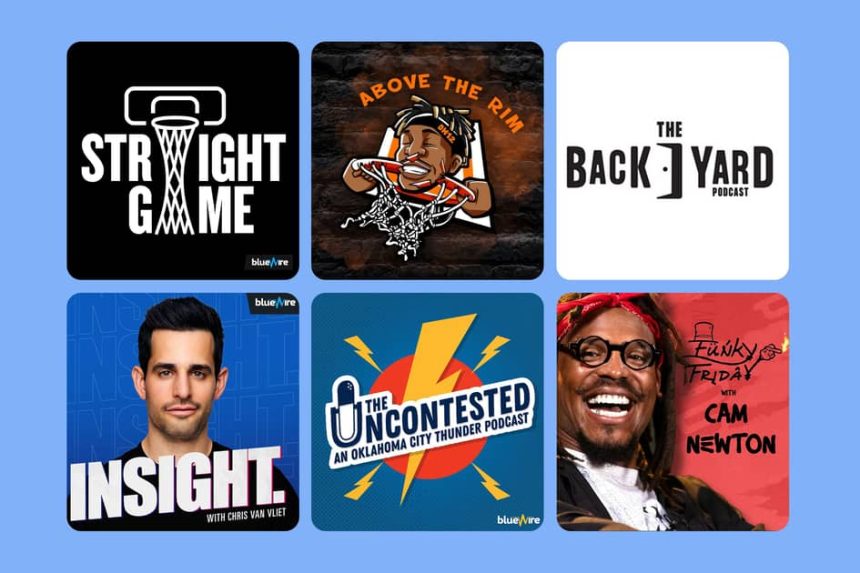
Now, a few years later, with about 20 million monthly listeners and viewers across dozens of shows covering everything from Nascar to fantasy football to women’s boxing, the network is also placing an increasing number of pro athletes behind the mic. In the past two years, Dallas Mavericks guard D’Angelo Russell, NBA legend Dwight Howard, former Carolina Panthers quarterback Cam Newton, and retired Dallas Cowboys wide receiver Michael Irvin have all signed on with Blue Wire.
Athletes are increasingly focused on building their own brands and off-court business ventures, presenting a business opportunity for Blue Wire. Kevin Jones, Blue Wire’s founder and CEO, favors hosts who come to the table with podcasts already up and running, he told Marketing Brew; in turn, hosts retain their IP rights and Blue Wire primarily helps monetize the shows through ad sales in exchange for a cut of revenue. For brands, much like with other celebrity- and influencer-led podcasts, athlete podcasts can be an attractive option, as they serve as something of a sponsorship shortcut.
“It’s a way to get an athlete endorsement without having to spend an arm and a leg, and [brands] get to support [the athlete’s] growing media channels,” Jones said.
While it’s still early days for the athlete-host strategy at Blue Wire, Jones said he has plans to expand the experiment further, including by leaning into live events and potentially recruiting more women and college athletes to the network.
Studio to stadium
So far, Blue Wire has sought out retired football players because they’re already “really polished media veterans,” Jones said, as well as basketball players, since there is considerable brand interest in the NBA. The network is also bolstered by a slate of more than 100 team-focused shows, which can also bring in sizable audiences and millions of dollars in revenue, he added.
Athlete celebrities bring big audiences with them, too. Newton, who has more than 1.7 million subscribers on YouTube, is a “clear star for us,” Jones said, and last month, a segment sponsored by Wonderful Pistachios on Newton’s show 4th&1 with Cam Newton went viral, racking up 454,000 views on TikTok, 443,000 on Instagram, and 22,000 on YouTube. When Russell and Howard brought their shows to Blue Wire in March along with fellow NBA veterans Victor Oladipo and Penny Hardaway, their formerly independent shows brought an additional 445,000 YouTube subscribers and about 9 million Instagram followers to the network.
Russell and NBA content creator Logan Linkmeyer, who cohost The Backyard Podcast, landed PrizePicks and Ro as the first two sponsors of their show, which has also served as an early case study for Jones in live events. Earlier this fall, the Blue Wire team worked with Russell to bring Johnnie Walker on as the sponsor of the second edition of his Backyard Cup event, a Ryder Cup-style tournament where NBA players face off on the green against YouTubers. Live tours with Howard and Irvin are in the works for next year, Jones said.
Get marketing news you’ll actually want to read
Marketing Brew informs marketing pros of the latest on brand strategy, social media, and ad tech via our weekday newsletter, virtual events, marketing conferences, and digital guides.
“Calling ourselves a sports podcast network is not accurate anymore,” Jones said. “There’s so much more that we can do together…How do we take these athletes away from the podcast desk and do unique things like…parties with them as we continue to evolve?”
Graduating class
Jones also sees opportunities in the NIL space. Blue Wire recently partnered with NIL platform Mogl to monetize content for college athletes and to, Jones said, “enhance our packages for certain brands, or to sell à la carte in certain situations.” Short-form social and live events are the priority for that cohort over podcasts, since most college students tend to have less time than retired athletes to commit to recording, Jones said, although that could change.
“A lot of these NIL athletes are more entrepreneurial than college athletes five to 10 years ago,” he said. “They already have some brand deal experience, or have some good ideas, or even have a production team around them.”
At Blue Wire, football and basketball remain the most popular sports, followed by college sports and golf, but Jones said he’s eyeing the women’s sports space moving forward, looking for athletes who already have their own shows and are seeking an ad sales partner. If Blue Wire does bring on women athletes as hosts, the company will be entering an increasingly crowded space: In recent years, podcast networks like iHeart and Wave Sports & Entertainment have doubled down on women’s sports podcasts and found success with audiences and advertisers alike.
Jones also said he’s thinking about how to work with up-and-coming, digital-first properties like Peoples League, a creator-owned golf league, to help connect brands with sports content.
“You don’t have to be huge and on TV,” he said. “If you have huge digital reach, we can bring sponsorships.”
Read the full article here