


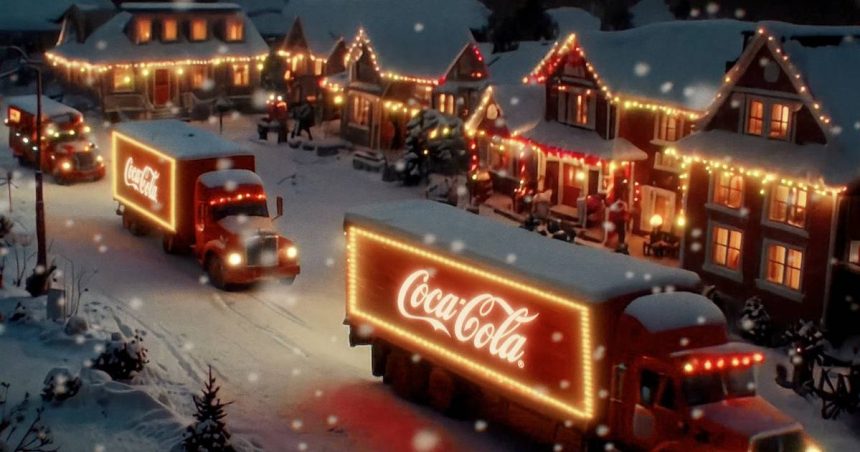
AI is coming for everything, even the Coca-Cola polar bears.
Last week, Coca-Cola joined brands like Toys R Us and Under Armour and dove into the AI ad game, this time with a series of remakes of the soft-drink brand’s nostalgic “Holidays Are Coming” spot from 1995.
Coke released three separate 60-second commercials, each produced by a different production studio, but all of which share the same smooth, AI aesthetic that, love it or hate it, has become identifiable with the technology’s use in creative production.
Like the original, the ads all share the same general plot: Coca-Cola delivery trucks barreling through places like San Francisco, Japan, and possibly even the Grand Canyon to deliver yuletide cheer as fuzzy and furry critters, including those Coke polar bears, look on.
Silverside.AI, a creative studio born out of the indie agency Pereira O’Dell, started working on one of the ads for the campaign in June, Rob Wrubel, Silverside’s founder and managing partner, told Marketing Brew. The studio, he said, was tasked with “re-imagining and re-inspiring” the 1995 spot using “AI techniques and tools.” In other words, yeah, Coca-Cola probably knew it would stir up a reaction.
To craft the ad, the Silverside.AI team used the AI platform Leonardo to generate images and then the AI video platforms Luma and Runway to animate them.
Tens of thousands of image frames were created, he said, and the team opted to limit how many humans were shown, noting that the tech still has limitations with creating realistic-looking people. The other two studios, however, did include AI-generated depictions of happy (and vaguely eerie-looking) human onlookers clutching sodas.
Traditional post-production tools were used to smooth out the kinks, including nailing the iconic Coca-Cola script on the side of the delivery trucks.
And the choir that’s heard singing the song’s refrain? That’s real, Wrubel said.
Though it’s hardly as big a production as driving real trucks through the Arctic Circle, sifting through a hundred different pictures of AI-generated squirrels is still a labor-intensive process, he said. Creatives prompted the platforms and determined which frames made the most sense to stitch together.
Get marketing news you’ll actually want to read
Marketing Brew informs marketing pros of the latest on brand strategy, social media, and ad tech via our weekday newsletter, virtual events, marketing conferences, and digital guides.
“In some ways, when people think of AI, they think it’s like this magic where you just write a simple sentence and then you suddenly have a whole video,” he said. The output is still “wild and overwhelming.”
Which prompts elicited these images? How specific did the team get? Wrubel wouldn’t say. “I won’t go into all the detail there,” he said. “I will just say that you have to be thoughtful, because we’re working with large LLMs that have very specific constraints about how they respond to brand names.”
On the utility of AI, the proposition is clear. Compared to a traditional shoot, AI tools can make production an “order of magnitude less expensive,” he said. The technology is also immediate. If a specific shot looks good in Egypt, for example, it can be re-created in Japan within a matter of hours.
“You can generate a close-to-rough-draft version of an idea within hours” instead of waiting “weeks or months to get a first cut of what you were trying to produce,” he said. And the creative ideation can also happen faster: “We’re having creative reviews almost hourly,” he told us.
But audiences don’t seem entirely sold on what they’ve seen. Like the other brands that have dipped their toes into artificially generated waters, the ads have received backlash for leaning on AI—including, in the case of Coca-Cola, an entire segment on Today dedicated to the commercials. The public isn’t holding back: On social media, users have called the campaign “soulless garbage” and “creepy,” and the brand was even accused by one user on TikTok of having “ruined Christmas.”
Yes, Wrubel has heard the criticism—and he isn’t dismayed. The goal was not to make something realistic, he said.
“Of course you always want everyone to just universally love it, but I’ve been through too many of these technology walls of worry. I’ve climbed over them,” he said. “I have the spirit of, this is bound to happen when big brands step in and want to innovate,” he said.
Read the full article here